
MSW Programs at University of Pittsburgh
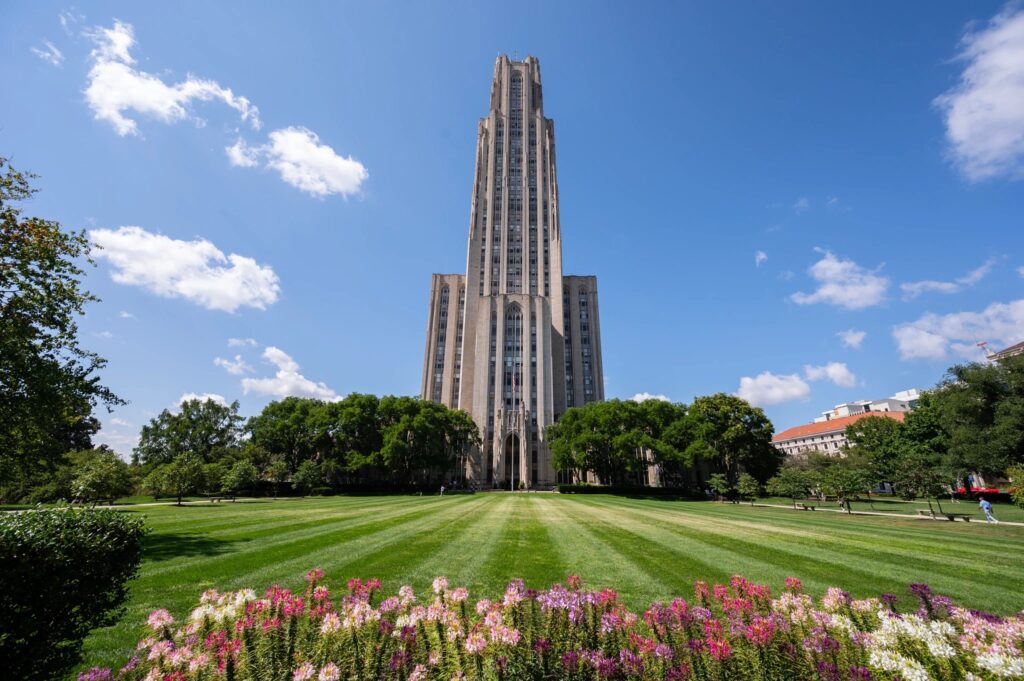
The University of Pittsburgh’s School of Social Work has been essential to social work education for over a century. Students who want to become social work practitioners have trained here since September 1918, when it replaced the Division of Social Work in the Department of Sociology. The school welcomed its first MSW class that same year. This legacy has made it one of the nation’s top social work programs, and it now ranks 12th among 319 schools for social work in the United States according to U.S. News & World Report.
Students and faculty head over to the iconic Cathedral of Learning in Pittsburgh’s Oakland section, where the School of Social Work occupies the 20th through 23rd floors. The school has led the way in innovative education throughout its history. It became the first school nationwide to create a community organization program and pioneered specialization in child welfare.
The school’s identity centers on building knowledge and using it to discover the full potential of people by tackling complex social problems. Its mission champions social and economic justice while building a society that values everyone’s dignity and achievements – individuals, families, and communities alike. The school aims to create brave leaders who change social work practice, policy, research, and education in an environment that welcomes everyone and works closely with communities.
Students learn the knowledge, skills, and values they need to work effectively with people from all backgrounds and communities. They analyze how personal, family, and environmental factors shape practice settings while standing up for people who face obstacles to reaching their potential.
The school goes beyond classroom teaching with strong research and community service programs. Faculty and students study complex social problems and find new ways to solve them. The school helps local, national, and international communities through partnerships with social agencies, community groups, government organizations, and foundations.
With connections to more than 600 practicum sites, students develop crucial social work skills through specialized and paid fellowships. They work in community organizations, healthcare settings, nonprofits, and other locations. This hands-on experience builds on classroom theory and prepares graduates for successful careers in social work of all types.
Programs offered
The University of Pittsburgh’s Master of Social Work (MSW) program features a strong curriculum that adapts to your needs. You can choose between two specializations that match your career goals.
The Direct Practice specialization prepares you to work with individuals, families, and small groups. This path gives you the skills needed to work in child and family services, hospitals, senior services, and similar settings. The Community, Organization, and Social Action (COSA) specialization helps you develop leadership abilities for community development, human services, and social change. COSA graduates often become grant officers, executive directors, researchers, and take other leadership roles.
Students must complete 60 credits minimum—42 in classroom and 18 in practicum. The curriculum blends theory with real-life experiences. You start with the generalist curriculum that builds your foundation in social work knowledge and skills. Next, you move to your chosen specialization that prepares you for advanced practice.
Pitt’s MSW degree lets you choose how you want to study. You can take traditional face-to-face classes or join the newer part-time online program. The online option focuses on Direct Practice specialization. You can complete it in 3.5 years with 100% asynchronous coursework while keeping up with work and personal life. More importantly, online students pay in-state tuition whatever their location.
You can boost your expertise with certificate programs while earning your MSW degree without adding extra time. Available certificates include:
- Children, Youth, and Families
- Integrated Healthcare
- Mental Health
- Gerontology
- Human Services Management
- Home and School Visitor/School Social Worker
- Community Organizing and Practice
Pitt also offers joint degree options for students interested in interdisciplinary education. You can combine an MSW/MBA or choose from three unique joint programs with the Graduate School of Public and International Affairs. These joint programs need 72-88 credits and take six to seven terms of full-time study.
The program includes carefully selected practicum experiences that put classroom learning into practice. Online students can complete these experiences in their local communities and might even use their current workplace as a practicum site.
About the online program
The University of Pittsburgh’s part-time online MSW program starts in fall 2025. This program creates a flexible path to advance your career or start fresh in social work. You can complete your coursework whenever it suits you best, which helps you balance your studies with work and life.
The program lets you earn your degree in 3.5 years with a specialty in Direct Practice with Individuals, Families and Groups. Non-advanced standing students take six credits each semester over 10 consecutive terms. Starting fall 2026, advanced standing students can transfer up to 21 credits from an accredited undergraduate social work program and finish in six consecutive semesters.
Students pay in-state tuition whatever their location – a huge financial plus. You’ll need to complete 60 credits total – 42 in the classroom and 18 in practicum. Each course just needs about 6-9 hours weekly, which includes self-paced learning modules, study time, and assignments.
The program’s standout features include:
- 100% self-paced online courses you can complete from anywhere, with direct access to faculty and peers
- No GRE needed for admission
- Optional certificates in Children, Youth and Families; Integrated Healthcare; and Mental Health
- Anti-racist/anti-oppressive curriculum that shows steadfast dedication to justice, equity, diversity, and inclusion
- Help finding practicum sites with options to include work-based practicum hours
- Career Center that provides immediate and long-term professional guidance
The program brings classroom learning to life through in-person practicum experiences in your community. These field placements help you apply what you learn through both generalist and specialized experiences.
The School of Social Work’s rich history of educational excellence shapes the curriculum. You’ll blend classroom theory with hands-on experience to serve communities with compassion and humility. Graduates gain skills to support human rights and promote social, economic, and environmental justice locally and globally.
The online program carries the same national recognition as on-campus learning, backed by the University of Pittsburgh’s status as a top-tier institution for social work education.
Accreditation
Accreditation plays a vital role in selecting a Master of Social Work program. The University of Pittsburgh’s MSW program has full accreditation from the Council on Social Work Education (CSWE) Board of Accreditation, which oversees all social work education programs in the United States. This recognition proves the program meets national standards for social work education.
CSWE accreditation carries immense weight. Students who choose Pitt’s accredited MSW program can trust their education follows professional standards. The validation goes beyond just the curriculum and includes faculty credentials, available resources, and student performance.
Pitt’s School of Social Work shows a strong dedication to meeting accreditation standards. The school’s Bachelor of Arts in Social Work program has kept its accreditation since 1974. This long history of excellence extends naturally to its graduate programs.
A CSWE-accredited program creates real advantages for your career path. You become eligible for full membership in the National Association of Social Workers (NASW), America’s largest professional social work organization. Members get access to networking events, educational resources, and professional growth opportunities.
On top of that, CSWE accreditation affects your path to licensure after graduation. Most states require students to complete an accredited program before taking social work licensure exams. Without this credential, your career choices become limited despite your educational investment.
The accreditation status helps students seeking advanced standing. Students with a social work degree from another CSWE-accredited undergraduate program in the last seven academic calendar years might qualify for advanced standing at Pitt. This option lets you finish your MSW faster by building on your existing knowledge.
The University of Pittsburgh School of Social Work ranks among Pennsylvania’s most respected social work education programs. Its reputation for excellence and proper accreditation ensures your investment in a Pitt MSW degree—campus-based or online—will prepare you for professional practice according to industry standards.
Admission Requirements
The University of Pittsburgh MSW Programs look at more than just your grades when making admission decisions. The school takes a complete view of each candidate and values both academic achievements and personal qualities that show you’ll succeed in social work education.
You’ll need a bachelor’s degree from an accredited college or university with a minimum 3.0 GPA (on a 4.0 scale) in your undergraduate work. Your bachelor’s degree can come from any field – it doesn’t have to be social work. The admissions team looks at your whole story, from academic background to work experience and personal drive.
Your application package for both face-to-face and online MSW programs must include:
- Official transcripts from all schools attended
- Current resume
- Two letters of recommendation (preferably one academic and one professional)
- Personal statement (prompts provided within the application)
Good news – you won’t need GRE scores or application fees. This makes the application process more accessible.
The admissions committee might ask for an interview if your GPA falls below 3.0, but you could still get provisional admission to the program.
Timing plays a vital role in your application. Applications open August 15, 2025, for the 2025-2026 academic year. Both programs offer early decision deadlines of October 15, 2025. Face-to-face programs have a priority date of February 1, 2026, while online programs set theirs for March 1, 2026. Final submissions are due June 1, 2026, and supporting materials must arrive by June 15.
Advanced standing could give you a big advantage if you have previous social work education. You might qualify if you earned your social work bachelor’s degree from a CSWE-accredited program in the last ten academic years. This status lets you complete your MSW with 39 credits instead of the usual 60.
Students with advanced standing can earn up to 15 academic credits based on their undergraduate coursework matching the MSW generalist curriculum. You might also get six practicum education credits if you completed practicum experience during your undergraduate studies. These credits require a “B” or higher grade and 400 practicum hours.
The online MSW program starts accepting advanced standing students in Fall 2026. This gives qualified social work professionals another quick path to advance their education.
Tuition
Money plays a crucial role in choosing between online and campus MSW programs at the University of Pittsburgh. A clear picture of all costs will help you make smart choices that match your budget and career path.
The online MSW program charges $1,079 per credit. Students save money because everyone pays in-state tuition rates, whatever their location. This brings huge savings for students from other states who study remotely.
Campus-based tuition changes based on where you live. Pennsylvania locals pay $26,876 for full-time study over two terms, $13,438 each term, or $1,079 per credit. Students from other states pay more at $39,112 for two terms full-time, $19,561 per term, or $1,595 per credit.
The joint MSW/MBA program has its own rates. Pennsylvania residents need to pay $30,398 for full-time study across two terms. Students from other states pay $48,830.
Regular fees add to your costs. Campus students must pay for transportation, student activities, wellness, and computer services. These total $815 per term for full-timers and $484 for part-timers. Online students only pay $112 per term for computer services.
The MSW program doesn’t charge an application fee. You just need to pay a $200 deposit that counts toward your first term’s tuition.
Other costs you should think about include housing at $4,905 per term, food at $2,959 per term, books and supplies at $308 per term, transportation at $483 per term, and personal costs at $1,251 per term.
Many students use federal need-based aid through grants, work-study, and loans to cover these expenses. Pitt’s undergraduate seniors and alumni who maintain good standing might get up to $1,250 per term in scholarships. Many employers also help with tuition costs through their assistance programs.
Additional Information
Life at the University of Pittsburgh as an MSW student goes beyond just academics. You will find many chances to grow both personally and professionally. The School of Social Work brings together students from local, national, and global communities who represent different areas of the profession.
The VanKirk Career Center will help you with tailored support for resume writing, interview prep, and salary talks. Campus and online students get career guidance no matter where they are. Each term features three licensure workshops that cover application steps and requirements for Pennsylvania residents. The center also helps out-of-state students with resources. After graduating, you’ll become part of a worldwide network of 340,000 alumni. The School of Social Work alone has contributed more than 11,000 graduates to this network.
The MSW Student Executive Council (SEC) makes student life better with several perks. Students can get up to $350 yearly to attend conferences and receive mini-grants for business cards. The council runs social events, helps students support each other, and puts together December graduation ceremonies.
Student life in Pittsburgh comes with great cultural benefits. PITT ARTS gives you free access to museums. You’ll find plenty of food choices and ways to get involved in the community. The university also takes care of your well-being with counseling services, stress relief programs, and complete health services during your studies.