
University of Iowa’s MSW Program
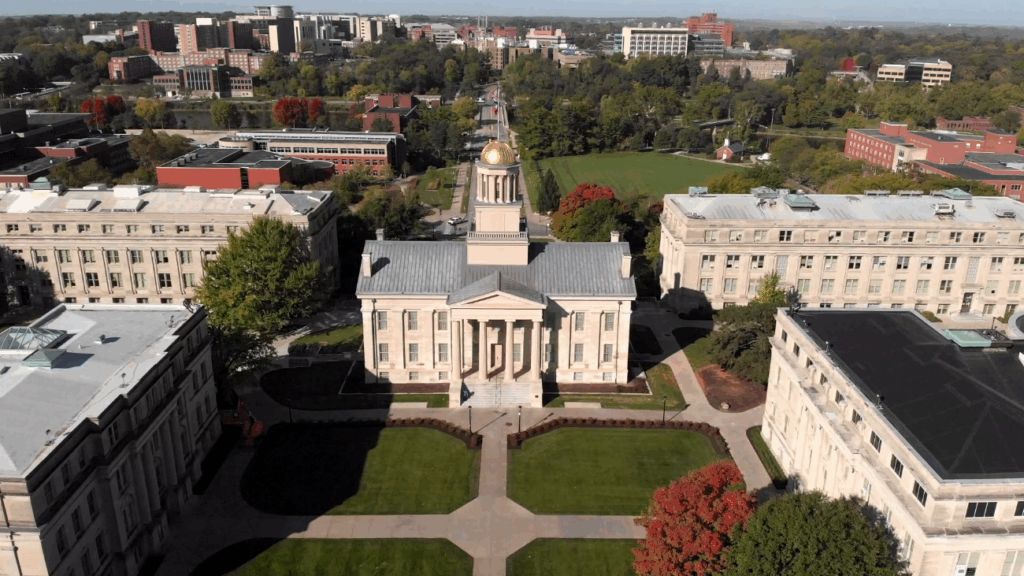
The University of Iowa’s School of Social Work is 110 years old with a rich history dating back to 1913. The school started as the Bureau of Social Welfare under the University’s Extension Division and has grown substantially over its century-plus journey. The current “New School” opened during the 1949-1950 academic year in the College of Liberal Arts, after the “Old School” closed in 1941.
The school aims to develop “culturally responsive practitioners, scholars, researchers, and leaders to create a more just society”. Students learn through strength-based points of view and systems-oriented approaches that prepare them to serve families and communities across Iowa and beyond.
North Hall, located on the east side of the main University campus along the beautiful Iowa River, offers students a dynamic Big Ten university environment. Students also get access to resources that only a major research university and health sciences campus can provide.
UI faculty teach most required courses in the program. Experienced MSW practitioners with excellent teaching reputations serve as adjunct faculty for electives and some required courses.
The MSW program has had accreditation from the Council on Social Work Education (CSWE) since 1951. The school focuses on creating practitioners who value social justice and professional ethics.
The University of Iowa School of Social Work stands out for:
- Groundbreaking distance education programs that serve the entire state
- Flexible part-time programs for working professionals
- Leadership in professionalizing undergraduate social work education
- Creating in-home family preservation services
The program’s rich history, academic excellence, and continuous innovation make it an ideal choice for future social work professionals who want established credentials with modern approaches.
Programs offered
The University of Iowa’s MSW program comes with two options that match your educational background. Students can choose from multiple locations and flexible completion timeframes that fit their schedule.
Here are the two main paths to enrollment:
- Regular Standing (54 semester hour option) – This path works best if you have completed a degree in any discipline other than a CSWE-accredited social work program. Students begin their journey in the fall semester.
- Advanced Standing (36 semester hour option) – This option is perfect if you have earned a BA in Social Work or BSW from a CSWE-accredited program. The program starts in the summer semester.
Students can pursue their MSW at several locations throughout Iowa. The program runs in Iowa City, Des Moines, Sioux City, and through an online platform. Most locations review applications yearly. The Sioux City program takes new students every three years.
The program lets you choose a timeline that works best. Advanced standing students in Des Moines and Iowa City can finish their degree in just one year (three semesters) or spread it over two years. Regular standing students can complete their studies in 2, 3, or 4 years. The online program offers similar flexibility, though advanced standing students follow a two-year structure.
You can specialize in one of two distinct tracks:
- Clinical Practice Specialization prepares you to work in mental health with individuals and families. You’ll find opportunities in nonprofits, hospitals, schools, and private practice.
- Leadership Practice Specialization teaches you to work with communities, develop programs, lead organizations, and advocate for social, economic, and racial justice.
The program also includes dual degree options that blend MSW skills with other professional fields. You can combine your studies with an MA in Urban and Regional Planning or an MBA from the Tippie College of Business.
The university’s Certificate in Aging and Longevity Studies adds another layer of expertise. This comprehensive approach to gerontology welcomes all UI undergraduate and graduate students in good standing.
A streamlined MSW curriculum helps you earn your degree with fewer semester hours, which saves time and money. The program’s well-laid-out structure and specialized fields like trauma and resilience, children and families, or school social work make it an excellent choice for your educational journey.
About the online program
The University of Iowa’s online MSW program matches the excellence of its on-campus counterpart. Students get the same high-quality education with added flexibility that works well for professionals and remote learners. The program holds full accreditation by the Council on Social Work Education (CSWE), letting you advance your career without moving.
Classes meet through Zoom on weekday evenings, Monday through Thursday. Students never start earlier than 5:30 p.m. Central Standard Time. This schedule works perfectly for working professionals who need a consistent routine to balance their job and studies.
Each cohort includes about 25 students. This small group setting encourages a supportive learning community even in the virtual space. Students build deep connections with classmates and learn from each other effectively. Local meetups happen twice a year where students connect with practicing social workers in their area.
State licensing rules currently limit enrollment to Iowa residents and those from six neighboring states. These states include Illinois, Minnesota, Missouri, Nebraska, South Dakota, and Wisconsin. Students from these states enjoy a significant benefit – they pay the same tuition as Iowa residents.
Success in this online program needs more than academic skills. Students should know how to manage time well, communicate online, handle basic tech tasks, and show strong reading and writing abilities. Self-motivation matters greatly in this somewhat self-paced setting.
Program options vary based on your background:
- A 36-semester-hour advanced standing program (for students with a BSW from a CSWE-accredited program)
- A 54-semester-hour regular standing program (for those without a BSW)
Regular standing students can choose 2-year, 3-year, or 4-year completion plans. Advanced standing students usually finish in two years while studying part-time.
Students can apply by December 1 for early review or February 1 for standard review. These options let you start your education when it fits your life and career best.
Accreditation
The University of Iowa’s MSW program stands out with its exceptional accreditation record. The Master of Social Work program has managed to keep its accreditation from the Council on Social Work Education (CSWE) since 1951. This makes it one of the oldest accredited programs in the country. The program’s seven-decade history shows its steadfast dedication to quality education.
The CSWE holds recognition from the Council for Higher Education Accreditation. It’s the only body that can accredit social work education programs across the United States and its territories. This makes CSWE accreditation a big deal for students and employers. The University of Iowa renewed its accreditation status in 2018, proving it still meets strict educational standards.
Numbers tell the real story of the program’s success. Iowa MSW graduates achieve a 90.4% licensure pass rate, which is a big deal as it means that they outperform the national average of 73%. These results show how well the program prepares students through coursework and field experience.
CSWE builds its accreditation on a competency-based education model that zeros in on student learning outcomes. Students learn practical skills and get measurable results, not just theory. The program uses several tools to check each competency, and at least one assessment comes from real or simulated field work.
Online students get the same CSWE-accredited degree as on-campus students. The accreditation applies to all program formats, whatever way you choose to study.
A CSWE-accredited degree matters after graduation too. State licensing boards usually need candidates to graduate from CSWE-accredited schools. Without this credential, you’ll hit roadblocks trying to get professional licenses – something you need to move up in your career.
The program reviews student achievement across nine social work competencies for both generalist and specialized practice. Faculty members check these outcomes and update findings every two years at least. This helps keep the education quality high and relevant as the profession changes.
Admission Requirements
The University of Iowa MSW program and Graduate College have set several criteria that applicants need to meet. A bachelor’s degree from a regionally accredited American college or university (or equivalent) is required, and students must maintain a minimum grade-point average of 3.00.
The application process follows specific deadlines. Students who submit their applications by December 1 will receive decisions by January 31. Applications received between December 2 and February 1 get responses by March 31. The Des Moines and Iowa City one-year advanced standing programs accept applications only until December 1.
Your application package must include:
- University of Iowa graduate admissions application with appropriate fee
- Two-page statement of purpose (with additional questions for advanced standing applicants)
- Brief School of Social Work supplemental data form
- Resume
- Contact information for two references (one academic and one professional)
- Unofficial transcripts from all colleges attended (except the University of Iowa)
After submitting your Graduate College application, you’ll receive email instructions about accessing your MyUI admission profile. This profile lets you upload documents and submit reference information. Your reference writers will get an email with a link to complete the required recommendation form and attach an optional letter.
Students with GPAs below 3.00 might still qualify for admission. The School of Social Work can ask the Graduate College dean for an exception if the applicant shows strong academic or professional achievements that suggest potential success in the MSW program.
The MSW program stands out from many other social work programs by not requiring GRE scores. This approach helps talented candidates whose abilities might not show up well in standardized tests.
Advanced standing MSW students begin their journey in summer 2026 for Iowa City, Des Moines, or online programs, while regular standing students start in fall 2026. Sioux City’s schedule differs – regular standing begins in summer 2026 and advanced standing starts in summer 2027.
Tuition
Planning your MSW education requires you to think about the financial commitment. The University of Iowa charges $626 per credit hour for resident tuition in the MSW program. Students from Illinois, Missouri, Nebraska, South Dakota, Minnesota, and Wisconsin who join either the Sioux City or online MSW programs can also benefit from this resident rate.
Graduate students need to pay a technology fee between $145 and $290 based on their enrollment hours. The University Registrar’s website has a complete tuition and fees table where you can look up costs for your specific program and location.
You can fund your education through these options:
- Financial Aid – The Office of Financial Aid & Scholarships helps students explore graduate education funding options
- Graduate Tuition Scholarships – These are available mostly for students without assistantships or employer tuition support. First-generation students, those from disadvantaged backgrounds, students with disabilities, and graduating students get preference
- Graduate Assistantships – The School provides quarter-time (10 hours/week) teaching assistantships during fall and spring semesters, usually in Iowa City
The total program costs vary depending on your track:
Advanced Standing MSW students (37 credits) pay about $21,510 including all fees at similar Iowa institutions. Foundation MSW students (60 credits) typically invest around $36,337 including all fees.
Your financial planning should include yearly expenses like housing and food, books and supplies, personal expenses, and transportation.
The University understands that getting a graduate degree can be financially challenging for many students. Students can make their educational goals more achievable through assistantships, loans, and student employment opportunities. Note that costs and funding options differ between departments and programs, so research specific information for the MSW program.
Additional Information
The University of Iowa MSW program goes beyond classroom learning to help you grow professionally. A thriving network of over 6,000 alumni worldwide shapes the program’s future. These graduates actively participate in Professional Advisory Committees and supervise practicum students while creating continuing education programs.
You’ll get access to specialized research tools like PsycINFO, Social Work Abstracts, and Social Services Abstracts. These databases provide complete coverage of professional literature in psychology, social work, and related fields that support your studies and future practice.
The job market looks bright. The U.S. Bureau of Labor Statistics expects social work positions to grow 6% between 2024 and 2034, outpacing other occupations. Your career path could lead to roles as a clinical social worker, medical social worker, school social worker, or policy promoter among many more options.
Students can share their thoughts through surveys, course evaluations, and student organizations. The MSW Handbook is a great way to get curriculum details, university policies, and administrative information.
The school updates job listings monthly for positions in Iowa and nearby states. These resources, combined with professional development services, help ensure your success during school and after graduation.