
Online & Campus MSW Programs at Tulane School of Social Work
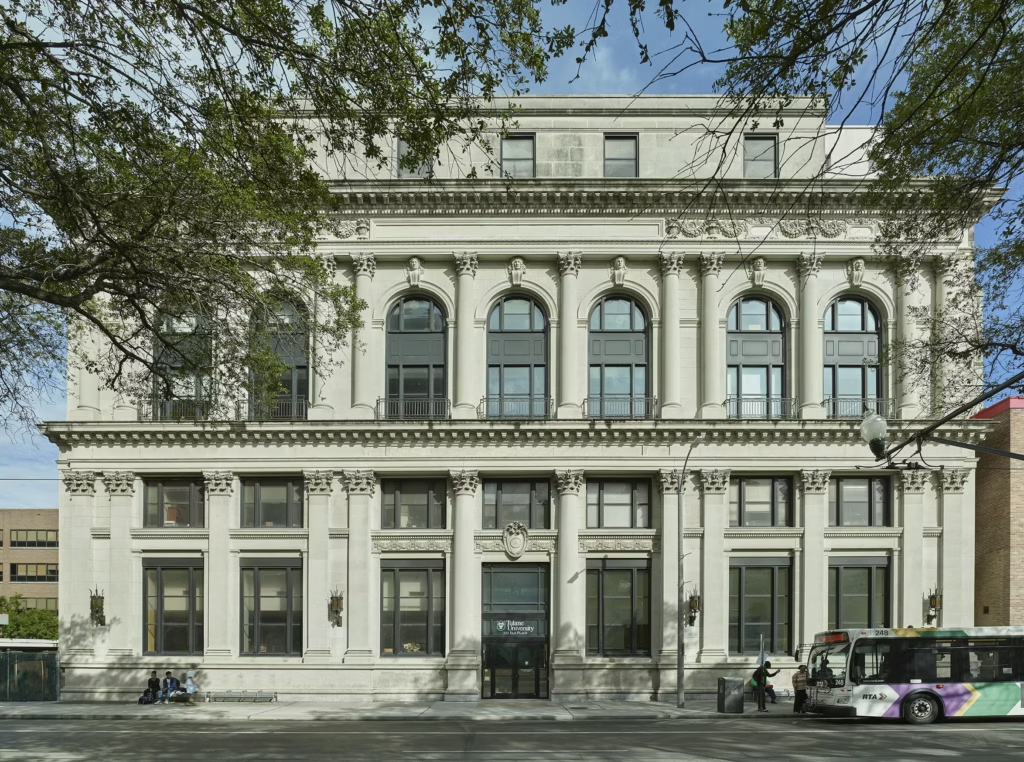
Dating back to 1914, Tulane School of Social Work emerged as the first social worker training program in the Southern United States. The school’s story began at the Kingsley Settlement House, where Tulane faculty started offering social welfare classes. American Red Cross funding helped formalize the program in 1921, and Rockefeller grant support transformed it into a separate program by 1927.
Students learn at the school’s downtown New Orleans campus at 127 Elk Place in the Central Business District, right across from the French Quarter. This urban location gives students a chance to work with communities of all types while experiencing New Orleans’ unique culture.
The school dedicates itself to “enhancing the well-being and equitable treatment of diverse individuals and communities through transformative education, generation of knowledge, service, and community engagement”. The institution aims to create innovative graduate programs through advanced research and trains future leaders to deliver evidence-informed, interdisciplinary practice locally and globally.
Tulane School of Social Work has broken many barriers at the university. Dr. Elizabeth Wisner became the first female dean at Tulane in 1937. The school led Tulane’s desegregation efforts and became the first division to welcome African American students during the 1962-63 academic year. It also appointed the university’s first African American faculty members.
The school is Tulane University’s most diverse division. African American student enrollment has grown by 113% while Hispanic student numbers have jumped by 121%. Faculty diversity has expanded from 16% to 42%, showing the school’s steadfast dedication to inclusive education.
The Council on Social Work Education (CSWE) has accredited the school since 1927, making it a charter member of this standard-setting organization. The MSW program earned accreditation for the full eight-year cycle with no contingencies.
Success extends beyond accreditation. The MSW program equips students for professional achievement – 84% pass the clinical exam and 81% succeed in the Licensed Master Social Worker exam. These results highlight the school’s academic excellence.
Tulane University belongs to the Association of American Universities, an elite group of 62 leading research universities in the United States and Canada. U.S. News & World Report’s 2017 edition placed Tulane 39th among U.S. national universities. Newsweek recognized it as one of the top 25 most service-minded schools.
The Master of Social Work degree has been awarded to more than 6,000 students from all 50 states and over 30 countries throughout the school’s century-long history, solidifying its position as a leader in social work education.
Programs offered
Tulane’s Master of Social Work (MSW) degree comes with multiple paths that fit your schedule and learning priorities. The MSW program brings together clinical and community-based practice. You’ll build on personal, cultural, and community strengths that help promote healing and growth.
You can pick from these program formats at Tulane:
- On-Campus MSW (16 months) – You’ll experience New Orleans-style social work at the downtown campus, and many students get job offers right from their practicum internship sites.
- Online MSW (16 or 32 months) – Evening classes happen in real-time (Central Time) and work great for professionals. You can finish full-time in 16 months or take the part-time route over 32 months.
- Advanced Standing Program (12 or 24 months) – This fast-track option works for students who earned their BSW from a CSWE-accredited program in the last five years. You’ll finish in 12 months full-time or 24 months part-time.
Tulane also lets you customize your education with these options:
Focus Areas (at no additional cost):
- Disaster and Collective Trauma – This rare program prepares you to handle psychological effects of crises through an anti-oppressive lens.
- Mental Health, Addiction, and the Family – This unique focus area centers on healing in relationships and gives you mentorship chances with national experts.
Dual Degree Options:
- MSW/MS-DRL (Disaster Resilience Leadership) – Available online and on-campus, this five-semester program combines 51 credit hours in social work with 24 credit hours in disaster resilience leadership.
- MSW/MPH – You’ll benefit from the nation’s oldest School of Public Health and fifth oldest School of Social Work (on-campus only).
- MSW/JD – You’ll develop cross-disciplinary skills through Tulane’s top-ranked Schools of Law and Social Work (on-campus only).
Field education is part of every program—900 hours over three semesters for full-time students or six semesters for part-time students. This hands-on experience often leads to jobs through practicum sites.
The content stays similar across all formats. You’ll work on team projects, problem-based learning, creative simulations, experiential assignments, student-led discussions, and fieldwork to build clinical and community-based practice skills. The main difference shows up in how classes are scheduled and delivered.
Whatever path you pick, you’ll leave with more than just a degree. You’ll carry a passion for service, dedication to social justice, and belief in everyone’s dignity.
About the online program
Tulane’s online MSW program brings its unique New Orleans-influenced curriculum right to your home through live, interactive classes. Students connect in real-time evening sessions that feel just like a traditional classroom. You’ll interact directly with your professors and classmates.
Classes start at 5:30 or 7:45 PM Central Time and run for two hours. This schedule lets many students keep their jobs while studying. The time commitment is substantial, so working full-time might be challenging with a full course load.
Your time investment changes each semester. Part-time students usually spend:
| Activity | Semester 1 | Semester 2 | Semesters 3-8 |
| Class Sessions | 6 hours | 9 hours | 7 hours |
| Practicum | — | — | 12 hours |
| Homework* | 12 hours | 18 hours | 12 hours |
| Total Weekly Hours | 18 hours | 27 hours | 31 hours |
*Students typically spend 2 hours on homework for each hour of class time.
You’ll complete 900 hours of field-based education beyond your regular classes. The program pairs you with an organization in your community so you can get hands-on experience near home. Your coursework and fieldwork support each other, making every minute of your education count.
The program uses cutting-edge technology to deliver the full Tulane experience. The platform offers sharp images and clear sound. Everyone can see each other and the instructor clearly. You’ll get personal attention throughout, including tech support and virtual office hours with faculty.
Students don’t need to visit campus at all. Everything happens online except your local internship placement.
Your success in the online program depends on having the right technology. Your computer should be less than five years old and meet specific requirements. We recommend using headphones to cut down background noise for you and your classmates.
The program lets you focus on social work areas that interest you most. After completing the basic curriculum, you can shape your specialization to create an education that fits your goals.
Accreditation
CSWE accreditation is the gold standard for social work education in the United States. Your choice of MSW program will benefit from knowing what this credential means.
CSWE is the only accrediting agency for social work education that the Council for Higher Education Accreditation recognizes. Since its founding in 1952, this nonprofit organization has accredited about 340 MSW programs across the country. Another 20-plus programs are working to meet these accreditation standards. Tulane social work programs have this accreditation, which shows they meet the highest educational standards in the field.
The Tulane MSW program ranks in the top 14% of Best Schools for Social Work in the U.S. The program earned accreditation for the full eight-year cycle without any conditions. This achievement shows its exceptional quality in every area evaluated.
CSWE accreditation brings several key benefits. The programs must follow specific requirements that support professional values and get you ready for real-world challenges. A detailed peer review looks at several factors:
- 900+ hours of field experience
- Faculty qualifications (including CSWE-accredited MSW and doctorate degrees)
- Student outcome assessment plans
- Strong staffing and financial resources
- Student-friendly policies that value their input
Programs need to show they’re skilled in nine core areas, from ethical behavior to policy practice and social justice. This detailed evaluation happens every eight years, and programs must keep improving their quality.
Your career prospects depend heavily on CSWE accreditation. Every state requires clinical social workers to have a license, and many states need it for non-clinical roles too. A degree from a CSWE-accredited school like the Tulane online masters program lets you qualify for master’s-level social work licensure anywhere in the U.S. and D.C.
The benefits go beyond getting licensed. State boards specifically ask for degrees from CSWE-accredited schools, which makes this credential crucial for growing your career. These programs also follow the best teaching practices. They offer quality coursework and ensure faculty members bring both academic knowledge and real-world experience to their classes.
Tulane’s CSWE-accredited program gives you confidence that your education meets professional standards and prepares you well for your career. This dedication to excellence through accreditation is central to Tulane’s approach to education.
Admission Requirements
The Tulane social work program offers a selective yet straightforward admission process. The school welcomes candidates who demonstrate strong academic performance and dedication to the field. Their 80-85% acceptance rate reflects this approach.
Qualified candidates must have a bachelor’s degree from an accredited institution. The program values students with a well-rounded liberal arts background that includes humanities, social sciences, and human biology courses. Most successful applicants maintain a grade point average of 3.0 or higher on a 4.0 scale.
Students need to submit these essential application materials:
- Statement of Interest – Write a three to five double-spaced page essay about your social work journey, qualifications, potential challenges, and your experience with diverse communities
- Resume or CV – Showcase your professional and academic achievements
- Official Transcripts – Submit records from all post-secondary schools attended, with proof of degree completion
- Two Letters of Recommendation – Request letters from academic or professional references, not personal contacts
The Tulane MSW stands out from other graduate programs because it doesn’t require GRE scores. The Admissions Committee takes an all-encompassing approach to review applications. They look at grades, experience, personal essays, and how well candidates match the program’s mission.
International students who speak English as a second language must submit TOEFL scores. They need to score at least 600 (paper-based), 250 (computer-based), or 90 (internet-based).
The Tulane online masters in social work uses a rolling admissions process and reviews applications as they arrive. The final deadline falls on March 31st, and early applicants have better chances at scholarship opportunities.
BSW degree holders might qualify for Advanced Standing status and complete their MSW in just three semesters. This option needs a 3.3+ cumulative GPA and a B+ average in practicum courses. The BSW must come from a CSWE-accredited program within the last five years.
Tuition
Planning your finances carefully is essential when pursuing a Tulane social work education. The programs use a per-credit-hour tuition model that varies slightly between formats.
The on-campus MSW and Disaster Resilience Leadership programs cost $1,276 per credit hour for the 2023-2024 academic year. Students must also pay a $60 per credit hour academic support service fee, which is capped at $536. University fees amount to $816 for full-time students taking 9+ credit hours, while part-time students pay $180.
Tulane online masters programs charge similar per-credit tuition rates at $1,276, but replace campus-based fees with a $100 technology fee. Online MSW tuition will increase to $1,403 per credit hour by Summer 2025. The online DSW program will cost $1,421 per credit during this period.
Graduate students need at least 9 credit hours per semester to maintain full-time status. Online DSW students can expect to pay approximately $13,875 per semester in 2025, including books and supplies.
Tulane offers both merit and need-based discounts to all Masters-level students. Your undergraduate GPA determines merit discounts at admission. Need-based awards, also called “scholarship top-offs,” typically arrive one month before your term starts.
The traditional MSW program costs about $69,000 in total, while the Advanced Standing program costs around $50,000. Most students receive financial aid through loans, work-study grants, or need-based federal aid.
Students should submit their Free Application for Federal Student Aid (FAFSA) early in the admission process to maximize financial aid opportunities. Graduate students can borrow up to $20,500 annually through federal loans. Private education loans based on creditworthiness are available if federal loans don’t cover all expenses.
Tulane’s tuition rates remain lower than many peer institutions while delivering top-tier programs that equip you to help individuals, families, and communities.
Additional Information
The Tulane social work program excels beyond classroom training with strong post-graduation support. Graduates become part of a dynamic alumni network that connects social justice-minded professionals across all 50 states and over 30 countries. Regular nationwide events help build both professional relationships and personal connections.
MSW Alumni Board members organize networking events and guide current students through their journey. The program sends quarterly newsletters that showcase faculty and student community projects, keeping graduates connected.
Career outcomes stand out in the Tulane MSW experience. A remarkable 99% of public health graduates find employment, pursue further education, or serve in the military within their first year. New graduates report median starting salaries between $60,000-$69,999.
The program supports job seekers through two specialized platforms:
- Handshake – Tools that boost networking and professional development
- CareerShift – A single site that combines contact details and job postings
Tulane online masters alumni can access the Center for Lifelong Learning’s continuing education resources, which help maintain their professional licenses. Social workers need to expand their knowledge and skills continuously to serve their communities better.
The job market looks promising. Social work positions should grow 7% from 2022-2032, outpacing other professions. Tulane’s blend of quality education and ongoing professional support helps create lasting career success.