
University of Illinois at Urbana-Champaign MSW Program
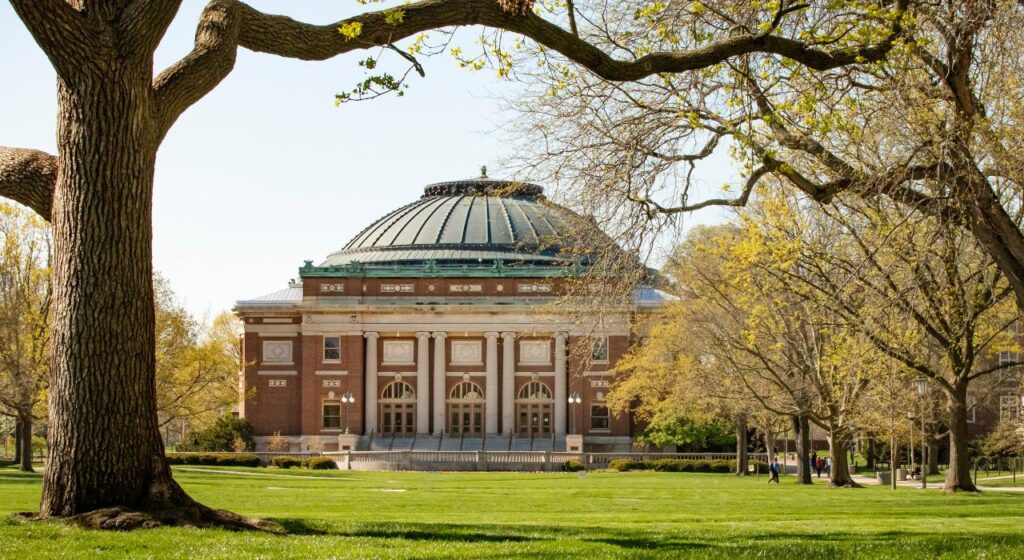
The School of Social Work at the University of Illinois at Urbana-Champaign has been essential to social work education since its establishment in 1944. Dean Ben Lough took the helm in May 2023, and the school has flourished into a dynamic academic community with 546 students—260 undergraduates and 286 postgraduates.
Students learn at 1010 W. Nevada Street in Urbana. The school’s mission focuses on providing well-rounded education based in liberal arts while preparing graduates to excel in social work practice, policy development, community work, and leadership. Kate Wegmann leads the MSW program, which showcases this mission through hands-on learning and challenging coursework.
The University of Illinois at Urbana-Champaign MSW program stands out with its steadfast dedication to social justice and equity. Students and faculty work together to create meaningful change through education, advocacy, and action. Their innovative research shapes evidence-based practices that transform social work’s future.
Aspiring social workers find many advantages in this program structure. Small class sizes make learning easier and more engaging. Students receive personal guidance throughout their academic trip and dedicated field support. Award-winning faculty offer one-on-one mentorship. This student-focused environment helps create professional growth and academic success.
Block placement internships give students valuable hands-on experience. These immersive opportunities connect classroom concepts with professional practice. Students build confidence, develop skills, and create professional networks while making a difference in real-life settings.
The program’s success shows in its impressive 90% job placement rate for MSW graduates. The school also offers three degree programs with online options for both BSW and MSW students. This flexibility accommodates different learning priorities and life situations.
Students at the School of Social Work learn specialized skills to help people facing various challenges. These include poverty, unemployment, substance abuse, mental illness, disabilities, chronic illnesses, and survivors of domestic violence or sexual assault. Graduates can pursue many career paths—from general social work to advanced graduate studies. Other opportunities exist in communications, corrections, business, education, government, healthcare, human resources, law, non-profit organizations, religious studies, and public service.
Programs offered
The MSW program at the University of Illinois at Urbana-Champaign features a flexible curriculum that fits various career paths in social work. Students need 44-72 graduate coursework hours, with individual requirements based on their prior education, coursework, and experience. Most full-time students finish the curriculum in 16-18 months.
Students can choose between two distinct concentrations that align with their specific career goals:
Advanced Clinical Practice Concentration: This track prepares students for direct clinical practice with individuals, families, and groups. The methods coursework focuses on clinical approaches that give you specialized skills for therapeutic intervention and case management. Students pursuing licensure for clinical practice will find this concentration particularly valuable.
Leadership & Social Change (LSC) Concentration: This concentration builds skills in advanced macro practice, different from the clinical focus. Students learn strategies to create change at organizational and community levels instead of working with individuals. The LSC concentration creates paths toward leadership/administration or advocacy/policy development roles. Each methods course maintains a macro focus to strengthen students’ abilities as change agents within systems and communities.
Both paths require a field placement or internship lasting one to two semesters, with a minimum of 900 hours in an approved setting. This hands-on experience offers a real-life application of classroom learning.
The program features these specialized focus areas within the concentrations:
- Advocacy, Leadership, and Social Change
- Children, Youth, and Family Services
- Health Care
- Mental Health
- School Social Work
Students with a Bachelor of Social Work (BSW) from a CSWE-accredited program earned in the last seven years might qualify for Advanced Standing admission. This accelerated option needs just 44 credit hours over three semesters, and most students can complete it in 12 months. Students in the school social work concentration usually need 16 months due to specific internship requirements.
The University of Illinois at Urbana-Champaign MSW program offers both on-campus and online options to suit different learning styles. While program descriptions typically show full-time enrollment models, students balancing other commitments can choose part-time options.
About the online program
The University of Illinois at Urbana-Champaign’s MSW program lets working professionals advance their careers without moving or leaving their jobs. This online, part-time Master of Social Work program works great for non-traditional students. You can keep your full-time job while getting your degree.
This online MSW program does more than just offer convenience. Students in rural or remote areas can now get their graduate degree through online classes and field placements in their local communities. This setup helps fill critical workforce gaps in Illinois’s underserved areas.
The MSW program offers two different paths:
Advanced Standing Path:
- You’ll need a BSW from a CSWE-accredited program earned in the last 7 years
- You’ll complete 32 credit hours of advanced coursework
- You’ll do 1-2 semesters (12-24 credit hours) of field placement
Traditional Path:
- This path fits students with non-social work degrees or BSWs from non-CSWE-accredited programs
- You’ll take 16 hours of foundation coursework plus 32 hours of advanced courses
- You’ll need a two-semester field internship that adds up to 24 credit hours
The online program matches the academic standards of on-campus classes. It features the same Leadership and Social Change macro practice curriculum and requires 900 hours of field education. Most students finish in eight semesters part-time. Those who study year-round, including summers, can graduate in about 2.5 years.
The tuition for 2025-2026 runs $620.00 per credit hour. Your total costs will include books, supplies, housing, food, and other basics. While you won’t get direct bills for these extras (unless you live in university housing), they should factor into your budget planning.
Illinois has about 17 CSWE-accredited MSW programs. The online MSW program fits into this educational landscape perfectly. It ended up helping meet the growing need for qualified social workers in many specializations. Students can advance professionally, whatever their location or personal commitments.
Accreditation
The University of Illinois at Urbana-Champaign MSW program’s full accreditation from the Council on Social Work Education (CSWE) serves as a key quality marker. This accreditation will give a curriculum that meets national standards for professional practice.
CSWE accreditation means much more than just another credential. The program goes through a thorough peer-review process that balances outcome requirements while staying flexible to each program’s unique context. CSWE’s vision comes to life through this process as it works toward “ensuring a well-educated social work profession equipped to promote health, well-being, and justice for all people in a diverse society”.
A CSWE-accredited program can boost your career prospects significantly. You can apply for licensure right after you get your MSW degree. The University of Illinois curriculum meets educational requirements for licensure not only in Illinois but in all states that offer social work licensure. This opens up many career paths whatever state you practice in.
Quality social work education stands on a solid evaluation process. CSWE-accredited programs show their steadfast dedication to higher standards. They educate students to become respectful, responsible social workers who can serve communities of all types. Students learn critical thinking, problem-solving, and advocacy skills with a focus on justice, equity, inclusion, and diversity.
CSWE accreditation reflects social work education’s core purpose: building and maintaining healthy communities while adding to public good. This matches perfectly with the University of Illinois program’s focus on social justice and community participation.
The accreditation covers all approved program locations and delivery methods. Both on-campus and online iMSW options follow similar quality standards and recognition. Your degree’s professional credibility and licensure eligibility remain the same whichever path you choose.
CHEA (Council on Higher Education Accreditation) recognizes CSWE’s Board of Accreditation. This extra layer of validation protects you from “degree mills” and ensures your education investment leads to genuine professional credentials.
Admission Requirements
Your journey to the University of Illinois at Urbana-Champaign MSW program begins with meeting admission criteria. Each program track has specific requirements based on your educational background and career goals.
The standard MSW program requires applicants to meet these basic criteria:
- A baccalaureate degree from an accredited college or university
- Minimum 3.0 GPA (on a 4.0 scale) for the final 60 semester hours of undergraduate coursework
- At least 20 hours of coursework in social/behavioral sciences, humanities, and biological sciences
- Personal qualities that match the social work profession’s needs[132]
- Excellent communication and people skills
The Advanced Standing MSW program might be right for you if you’ve earned a BSW from a CSWE-accredited program in the last seven years. This fast-track option takes 12 months to complete with 44 credit hours over three semesters. It builds on your social work education foundation.
The Graduate College Application needs several items. Start by creating your profile with personal and educational details. Then submit these materials:
- Three letters of reference (academic or professional)
- Graduate College Academic Statement
- Social Work Personal Statement
- Current resume with relevant education, volunteer, and work experience
- Unofficial transcripts from all colleges/universities attended
Different program formats have different deadlines. Campus programs accept applications until January 15, for Summer (Traditional Students) and Fall (Advanced Standing Students). Online part-time programs have deadlines of December for Spring (Advanced Standing) and January 15 for Summer (Traditional).
International students need to meet extra requirements. These include English proficiency scores (minimum 103 on TOEFL iBT, 7.0 on IELTS) and a Declaration of Finances Form. No applicants need to submit GRE scores.
The admissions committee takes an all-encompassing approach to review applications. Meeting minimum requirements doesn’t guarantee acceptance. They look at academic performance and personal qualities that suggest you’ll succeed in social work.
Tuition
The University of Illinois at Urbana-Champaign MSW program comes with specific financial considerations. The 2024-2025 academic year shows a substantial difference in on-campus MSW tuition rates based on residency status. Illinois residents pay $16,684 for the academic year, while non-residents and international students pay $33,300.
The program’s costs stand out when compared to national averages. The university’s in-state tuition is higher than the national average of $12,422, which reflects its quality and reputation. The out-of-state tuition also exceeds the national average of $29,909.
Students should consider both direct university charges and indirect expenses beyond simple tuition. The total cost reaches about $35,862 for in-state students and $54,982 for out-of-state students. Financial aid and scholarships can reduce the average net price to $12,458 for Illinois residents and $42,086 for non-residents who qualify for need-based aid.
The online iMSW program has its own pricing structure. Students pay $620 per credit hour during 2025-2026, which makes it easy to calculate costs based on your chosen pathway and credit requirements.
Your budget should account for these additional expenses:
- Books and supplies
- Housing and meals
- Personal expenses
- Transportation costs
Students can access several financial aid options. The State of Illinois provides various programs that depend on annual appropriations. Federal financial aid programs add more funding possibilities. Social work education offers specific scholarships and grants that help many students.
The university bills students directly only for university housing, not other indirect costs. The Illinois Cost Calculator helps create individual-specific cost estimates based on your circumstances.
Early planning and understanding of these financial details can help you secure the right funding for your masters in social work at Illinois.
Additional Information
Students at the University of Illinois at Urbana-Champaign’s MSW program can explore exceptional research opportunities beyond their regular coursework. These hands-on experiences prepare them well for their future careers and advanced studies. Students work with leading social work scholars on current research projects that help them develop crucial skills.
The university publishes the Journal of Undergraduate Social Work Research (JUSWR), a peer-reviewed publication that features student research from social work and related fields. The journal welcomes various submissions including original research articles, policy analyzes, literature reviews, poster presentations, and creative pieces.
Research experience often paves the way to promising career opportunities. Social work careers are growing faster than most fields—6% from 2024 to 2034, compared to the national average of 3.5%. Healthcare social work shows even stronger potential, with healthcare sectors expected to add about 1.9 million jobs yearly between 2023 and 2033.
The program supports students with several resources and connects them to the Community Learning Lab. This lab creates valuable partnerships between students and community organizations. Students who need guidance can schedule meetings with Ellen Ritter.
Salaries differ by specialization. Child and family social workers earn a national median of $53,934, while medical and health services managers can make up to $110,677. MSW graduates typically earn $15,000 more annually than BSW holders. Job postings requiring a master’s degree offer around $78,200 compared to $68,000 for bachelor’s-level positions.
MSW graduates qualify for diverse roles such as licensed clinical social work, healthcare social work, mental health counseling, substance abuse counseling, and administration. The LCSW credential, available only to MSW degree holders, allows professionals to run private practices and accept third-party payments.