
Troy University’s MSW Program
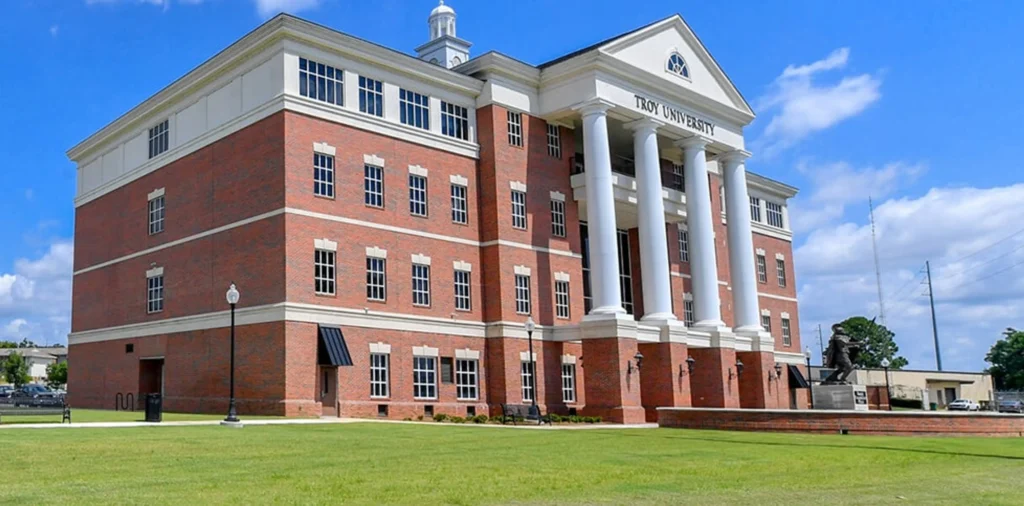
Troy University’s story began on February 26, 1887, when Alabama’s Legislature created it as a teacher training institution. The university started as Troy State Normal School and has grown into the institution we know today.
Troy University’s four Alabama campuses sit in Troy, Montgomery, Dothan, and Phenix City, giving students different learning environments. Troy’s flagship campus showcases classical architecture surrounded by lush green spaces that create a perfect college atmosphere blending tradition with modern educational facilities.
The university’s dedication to academic excellence and global outlook has never wavered. Nearly 15,000 traditional students and adult learners worldwide study at TROY, which prepares them to compete on the international stage. Almost 1,000 international students from more than 65 countries enroll yearly, creating a rich cultural learning environment.
Troy University has earned notable recognition for its academic quality and value. The Princeton Review has listed TROY among its “Best of the Southeast” for 21 straight years. U.S. News & World Report ranked TROY 45th among regional universities in the South and 19th among public regional universities in the South in 2023.
Troy University’s academic structure includes five colleges:
- College of Arts and Sciences
- Sorrell College of Business
- College of Communication and Fine Arts
- College of Education
- College of Health Sciences
These colleges offer programs that meet today’s competitive job market needs. TROY’s 19:1 student-to-faculty ratio allows for tailored attention while keeping high academic standards.
The Alabama Commission on Higher Education approved TROY’s change to a doctoral institution in 2023. This change lets the university offer unlimited doctoral degree programs and shows its ongoing growth. Students can now access advanced educational opportunities, including specialized programs like the Master of Social Work.
Troy University blends traditional values with innovative teaching approaches. Students get both theoretical knowledge and practical skills they need to succeed in their chosen fields.
Programs offered
Troy University’s Master of Social Work (MSW) degree prepares you to excel in advanced social work practice. The program helps enhance quality of life at different social organization levels. You’ll gain advanced knowledge, values, and skills to work in diverse, multicultural, and tech-oriented environments.
TROY’s MSW program uses a cohort model. You’ll move through the curriculum with your peers based on your specialization and program choice. The program offers two main paths:
- Advanced Standing Program (30 semester hours) – This program is perfect if you have a Bachelor’s degree in Social Work (BSW) from a CSWE-accredited program with a 3.0 GPA in your last 30 semester hours of social work coursework. Online students can start this accelerated option in January (application deadline: October 15) or August (application deadline: May 15).
- Foundation Program (60 semester hours) – This program welcomes students with bachelor’s degrees in any field from an accredited institution. You’ll need a minimum 2.75 GPA overall or 3.0 GPA in your last 30 semester hours. The program starts each August (application deadline: May 15) and runs both face-to-face (Montgomery campus) and online.
You can specialize in one of two areas:
- Direct Practice Specialization – This path teaches you to work closely with individuals, families, and groups. Your core courses include advanced practice with individuals, families, and groups, assessment and psychopathology, direct practice evaluation, plus 510 clock hours of field practicum.
- Organizational Leadership and Management Specialization – This track focuses on program evaluation, design and development, advanced policy analysis, and organizational leadership. You’ll complete 30 semester hours including a 9-hour practicum component.
Each specialization requires two advisor-approved electives. One must be a focused elective.
After graduation, you can take the social work licensure examination needed for professional practice in Alabama. The MSW opens doors to careers where you’ll help people in crisis, promote social justice, and improve community wellbeing. The program’s military focus makes it a great fit if you want to serve military families.
Students without a BSW start with foundation courses. These cover key topics like social policy, human behavior, research methods, cultural diversity, and direct practice with individuals, families, and groups.
About the online program
TROY’s MSW program gives working professionals a flexible online learning path. Students can choose from two online Direct Practice specialization pathways that match their background and career goals.
Students get the same quality education online as they would on campus. The online courses maintain the same high standards as traditional classroom learning. This dedication to excellence has helped TROY award 29,481 online degrees so far.
Your previous education determines which path you can take:
- The one-year Direct Practice MSW (for BSW holders) – Fully online with classes beginning every January (application deadline: October 15) or August (application deadline: May 15)
- The two-year Direct Practice MSW (for non-BSW holders) – Completely online with classes starting each August (application deadline: May 15)
Students can start their journey at five different times throughout the academic year with 9-week terms. This quick-paced format helps you earn your degree faster without compromising on quality.
TROY’s online platform combines flexibility with detailed support. Online students receive the same benefits as campus students – counseling services, writing center access, online tutoring, and career guidance. These resources are the foundations of student success in the program.
The Direct Practice specialization teaches you to work with individuals, families, and groups at a micro level. This focus is valuable especially when you have interest in clinical social work roles. Students can complete all coursework at their own pace, which helps balance education with work and personal life.
TROY is a 50-year old leader in educating working adults and military students. The university now offers 158 degree programs completely online, showing its dedication to making education available to more people.
Graduates of the online MSW program can meet professional social work licensure requirements in almost every state. This is possible because the Council of Social Work Education (CSWE) accredits TROY’s MSW program, which states require for licensure nationwide.
Accreditation
Your social work education’s credibility depends on proper accreditation. Troy University’s Master of Social Work program has full accreditation from the Council on Social Work Education (CSWE). This accreditation shows the program meets national standards for social work education.
CSWE accreditation is a key qualification marker that will shape your future career. You’ll be able to take the social work licensure examination after graduating from Troy’s MSW program. This qualification matters because you need social work licensure to practice in Alabama and across the United States.
A CSWE-accredited program is essential because:
- You can only get licensed if you graduate from a CSWE-accredited master’s program
- Employers value CSWE accreditation as proof of quality education
- You’re more likely to get financial aid at accredited schools
- It’s easier to transfer credits between accredited programs
Troy University’s MSW program has completed a detailed accreditation process. This shows their steadfast dedication to high educational standards. The program gives you thorough preparation for professional social work practice.
Troy University also has accreditation from the Southern Association of Colleges and Schools Commission on Colleges (SACSCOC). This regional accreditation lets TROY award degrees from associate to doctoral levels.
SACSCOC accreditation proves Troy University’s commitment to integrity and its ability to deliver quality education programs and services. This validation confirms the university’s excellence in faculty, academic programs, services, and finances.
The institutional accreditation helps qualified TROY students get federal financial aid and makes it easier to transfer courses between schools. SACSCOC regional accreditation typically covers public and private nonprofit schools offering various degree levels.
While regional accreditation covers the whole institution, specialized accreditation like CSWE focuses on specific academic programs or professions. Many Troy University programs have specialized accreditation, which shows their commitment to excellence in specific fields.
Choosing Troy University’s MSW program means your education meets both broad institutional standards and specific social work requirements. This dual accreditation gives you the credentials you need to get licensed and advance your social work career.
Admission Requirements
Troy University’s MSW program offers a simple application process that varies based on your education background. The program stands out because it does not require entrance exams, which makes it available to more students.
The MSW program needs specific documents to grant unconditional admission. You’ll need two reference letters from academic advisers, department chairs, college instructors, or employers. These letters should highlight your people skills, ability to handle graduate studies, career goals, and professional growth potential.
Your application package must include a detailed résumé that shows your education, work experience, career goals, memberships, volunteer work, and references. You also need to write a 500-750 word essay in APA format about why you want to pursue an MSW degree and what you plan to do after graduation.
A baccalaureate degree from a regionally accredited university is essential. You need a minimum overall undergraduate GPA of 2.5 or a 3.0 GPA in your last 30 semester hours. The MSW program typically asks for a minimum 2.5 GPA on the last 30 semester hours.
Students who don’t meet all requirements might qualify for conditional admission. This means you must maintain a 3.0 GPA during your first 9 semester hours. If you fall short, you’ll need to leave the program for a year before you can apply again.
Students can get temporary admission if they haven’t submitted all required documents yet. This option lasts one semester and follows the same rules as conditional admission.
After admission, remember these key requirements:
- Current criminal background check
- No more than two grades below “B”
- Overall GPA of 3.0 to graduate
- All credit must be earned within 8 years of graduation
Students with a BSW from a CSWE-accredited school can take the Advanced Standing Program’s faster track. Other students will join the two-year Foundation Program, which starts each August. The application deadline is May 15.
Faculty advisors will help guide your course selection and ensure you meet all program requirements after admission.
Tuition
Planning your MSW education starts with understanding the financial investment needed. Troy University’s graduate tuition costs $475 per credit hour for in-state students and $950 per credit hour for out-of-state students. The good news is that out-of-state students can qualify for in-state rates after waivers.
The MSW program’s total tuition and fees come to about $17,100. This amount varies based on your chosen track. Students in the 30-credit Advanced Standing program pay less than those in the 60-credit Foundation program because they take fewer courses.
Troy University provides these complete cost estimates to help you plan your finances:
| Expense Category | On-Campus | Off-Campus |
| Tuition (9 credit hours/semester) | $8,550 | $8,550 |
| Books & Supplies | $1,000 | $1,000 |
| Housing & Food | $10,068 | $10,860 |
| Transportation | $1,000 | $2,100 |
| Miscellaneous | $5,300 | $5,300 |
| Total | $26,314 | $28,206 |
Troy University stands out as a national model for quality, affordable education. Over the last several years, the university has frozen tuition rates to keep education available to more people. Board of Trustees president pro-tempore Gibson Vance explains: “As a board, our philosophy is to not raise tuition unless it is absolutely essential”.
Financial support options can help reduce these costs. About 70% of TROY students get some type of financial aid. The university’s graduate scholarships can lower your expenses. Students can apply for the Graduate Assistantship program that provides up to $7,500 yearly plus tuition support. Military scholarships are also available for service members and their families.
The best way to maximize your financial aid is to submit your Free Application for Federal Student Aid (FAFSA) early, between October and April. You can also spread out your payments throughout the semester instead of paying everything upfront.
Additional Information
The foundation of Troy University’s MSW program lies in ground skills gained through supervised practicums. Students complete in-person supervised practicum experiences at one of 350+ social service agencies that partner with TROY’s School of Social Work and Human Services. Students must complete a current criminal background check before starting their practicum to protect clients and students.
An MSW degree opens doors to career paths that go way beyond the reach and influence of traditional social work roles. Career options after graduation include human resources professional, health educator, community services manager, nonprofit leader, policy analyst, or child welfare worker. The program stands out from other MSW programs through its unique focus on military families.
Students can get financial support through the Joseph B. Harrington/Human Services Endowment Scholarship. The Department of Human Services and Rehabilitation, Department of Social Work, and Troy University Foundation created this scholarship. Since this scholarship helps undergraduate students mainly, graduate students should look for other funding options.
The Office of Practicum Education manages field experience completely – from curriculum design to student performance evaluation. Students create a Learning Contract with Individualized Work Plan with their Agency supervisor. This contract works as both a syllabus and evaluation tool for field education. This well-laid-out approach will give a perfect match between field experience and professional competency requirements.