
Utica University MSW
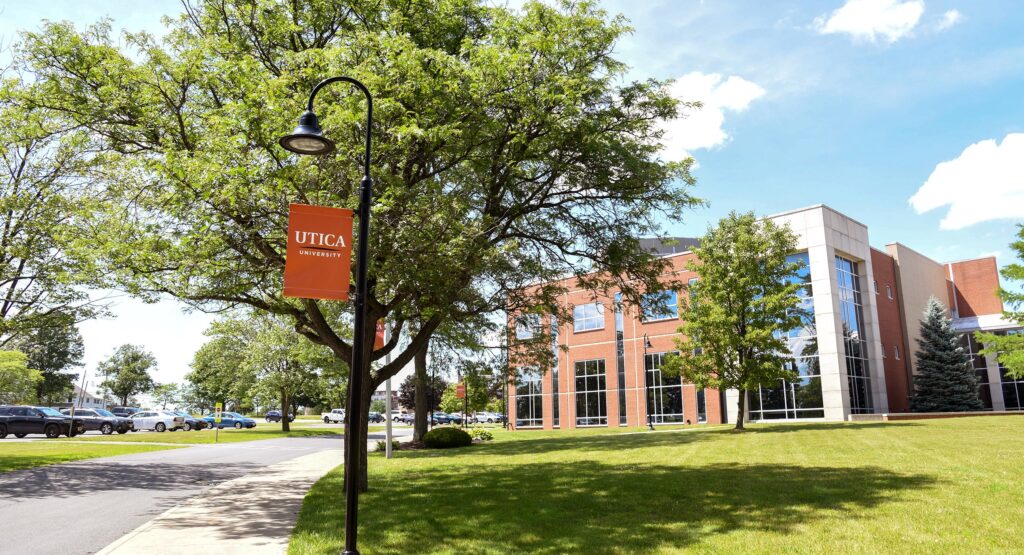
Utica College became Utica University in 2022, a change that better shows its 76-year-old legacy of academic excellence and innovative programs. The university sits on 128 acres in Central New York’s Mohawk Valley. Students enjoy beautiful green spaces alongside state-of-the-art learning facilities.
A 13:1 student-faculty ratio helps create customized academic experiences. The university welcomes a diverse group of 3,633 students – 2,335 undergraduates and 1,298 graduate students. Small class sizes make learning more effective, with 71% of classes having fewer than 20 students.
The university stands out in academic rankings. The 2026 edition of Best Colleges ranks it No. #76 in Regional Universities North and No. #50 in Best Colleges for Veterans. Students find a good balance of accessibility and academic challenge with an 87% acceptance rate and 46% four-year graduation rate. Graduates do well after school, earning a median salary of $57,422 six years after finishing their degree.
Students benefit from excellent campus facilities:
- The Clark Athletic Center features a 2,200-seat gymnasium, training rooms, weight rooms, and the Kunath Fitness Center with extensive exercise equipment
- Gaetano Stadium serves multiple sports with 1,200 spectator seats, stadium lighting, and synthetic turf
- The Todd and Jen Hutton Sports and Recreation Center covers 135,000 square feet with an eight-lane competition indoor track in one of North America’s largest air-supported domes
The university reaches beyond its main Utica campus with locations in Syracuse, NY, Latham, NY, and St. Petersburg, Florida. These sites support programs like the accelerated bachelor of science in nursing.
Utica University’s mission stays clear: “educating and preparing you for rewarding careers, responsible citizenship, enlightened leadership, and fulfilling lives by integrating liberal and professional study”. This guides their work to build an inclusive community that values different experiences while supporting freedom of expression.
The Social Work Department shows the university’s excellence through its Master of Social Work (MSW) program. The program specializes in recovery-oriented clinical social work. Students get individual attention with 8:1 ratios in field placement and 20:1 in coursework.
Programs offered
Utica University’s Master of Social Work (MSW) program stands out with its groundbreaking recovery values and clinical social work practice. This first of its kind program nationally focuses on recovery-oriented clinical social work. Students learn direct clinical practice skills to work with individuals, families, and groups.
Students can choose between two complete tracks based on their educational background. The traditional track needs 60 credits and welcomes students from any academic discipline. Students with a Bachelor of Social Work (BSW) degree earned in the last six years can take the Advanced Standing track with 30 credits. Both paths emphasize mental health assessment, treatment, and advocacy.
The program shines through its innovative curriculum that merges traditional clinical practice with recovery-oriented care. Students learn specialized skills in trauma-informed practice, recovery theory, and evidence-based mental health interventions. The curriculum has a unique four-hour personal counseling requirement. This helps students gain self-awareness and understand their clients’ experiences firsthand.
Working professionals will find the program’s flexibility a great advantage. The program runs entirely online with no residency requirements and takes just eight semesters to complete. Field placements work around flexible schedules, and students get all 900 required field hours in relevant clinical settings.
Small class sizes ensure students get personal attention. The program maintains an 8:1 ratio in field placement courses and a 20:1 ratio in generalist and specialization courses. This close mentorship prepares students well for their licensure exams after graduation.
MSW graduates have excellent career prospects. Social work jobs will grow by 7% from 2023 to 2033. The Bureau of Labor Statistics expects about 74,700 job openings yearly over the decade. Graduates can work as mental health clinicians, substance abuse counselors, case workers, health educators, or private practice clinicians.
New York state residents can apply to Utica University’s MSW program now. This program offers high-quality, recovery-focused clinical social work education right in the region.
About the online program
Utica University’s online Master of Social Work program offers a completely remote learning experience designed for working professionals. The academic year features six 8-week terms with a structured yet adaptable schedule. Students take one online course per term each semester to maintain focus and handle workloads better.
Students experience a mix of live and self-paced learning in virtual classrooms. Weekly 90-minute live sessions happen on set days, while additional coursework fits your schedule. Field seminars complement practical placements with 90-minute live meetings every two weeks.
Real-life experience stands at the heart of Utica’s MSW online curriculum. Students must complete 900 field hours before graduating, which prepares them for licensure exams and provides vital hands-on experience. Utica stands out by supporting supervised Work-Based Internships where students can meet requirements at their current workplace. Students can also choose from over 200 field opportunities across New York State or get help setting up a new placement contract.
Student success remains a top priority through personalized support. Each student works with both a Faculty Advisor and a Success Coach to direct program requirements and course registration. Small class sizes ensure quality education with student-to-faculty ratios of 8:1 in field placement courses and 20:1 in academic coursework.
The program welcomes applicants from New York State. Students can finish their degree completely online without residency requirements in eight semesters.
This groundbreaking curriculum leads the nation with its focus on recovery theories, values, and skills. The coursework features trauma-informed practice, mental health assessment, motivational interviewing, and cognitive-behavioral therapies. Students learn Acceptance and Commitment Therapy (ACT) to help people move from “better” to “well”.
The program, though fully remote, maintains strong dedication to:
- Racial equity and social justice
- Preparing students for successful licensure exam completion
- Supporting flexible scheduling to accommodate practical needs
- Engaging peer support networks to build hope for those in need
This fresh approach to social work education combines traditional clinical practice with recovery-oriented care, equipping you to strengthen diverse populations through a system-oriented, recovery-focused lens.
Accreditation
Utica University’s Master of Social Work program earned full accreditation from the Council on Social Work Education (CSWE), marking a major milestone for the institution. CSWE’s Board of Accreditation granted the university an original eight-year accreditation period that extends through June 2032. This recognition proves the program meets national standards for social work education excellence.
Students and graduates benefit greatly from CSWE accreditation. The accreditation will give graduates proof they have met educational requirements to practice as Licensed Clinical Social Workers (LCSW). This credential officially proves the quality of the program and competence of its graduates.
The program’s accreditation applies to all previously enrolled students, who will now graduate from an accredited program. Their professional standing and licensure eligibility remain protected through this retroactive recognition. The program held CSWE candidacy status before full accreditation, which showed it met the criteria to move forward in the accreditation process.
Program Director Joseph Hunter, Ph.D., calls this achievement “a major milestone that strengthens our ability to attract and enroll students who have a desire to earn their master’s degree to practice social work with our recovery-orientation framework, which is unique to our Utica University MSW program”. This unique recovery-oriented approach makes Utica’s program stand out nationwide.
Students looking into licensure should know that New York State officially registers the Utica University Online MSW program. The program prepares students to apply for applicable licensure or certification under New York’s educational requirements. Other states may accept the program’s educational requirements for licensure, though requirements vary by location.
Utica University holds complete accreditation through the Middle States Commission on Higher Education. Both the U.S. Secretary of Education and the Council for Higher Education Accreditation recognize this institutional accrediting agency. The university also has a charter from the Regents of the University of the State of New York, which further proves its academic excellence.
The university can operate its online MSW program in all State Authorization Reciprocity Agreement (SARA) participating states, with approval granted on January 4th, 2017.
Admission Requirements
The Utica University MSW program takes an integrated approach to review applications. Your academic background and professional experience both play key roles in the admission decision. The team looks at your GPA, work experience, personal statements, and references.
The Traditional MSW Track requirements include:
- A completed application with no GRE or GMAT requirement
- Official transcripts showing a bachelor’s degree from a regionally accredited institution
- Minimum 2.5 GPA (the team reviews applications below this threshold individually)
- A detailed personal statement that shows your steadfast dedication to social work values and explains how the program fits your career goals
- Two letters of recommendation from current/former work supervisors or course instructors
- A detailed résumé that highlights your relevant human services experience
The Advanced Standing Track has its own set of requirements:
- Bachelor of Social Work degree earned within the last six years (exceptions may apply based on relevant work experience)
- Minimum 2.75 cumulative GPA
- Personal statement that covers your BSW experience and MSW preparation
- Two professional recommendation letters
- Most recent BSW field evaluation
The university makes it clear that life or work experience never counts for course credit. The admissions committee reviews all applications and might offer conditional non-matriculated admission to candidates who don’t meet every requirement.
Students with conditional admission must complete two first-semester courses with B grades or higher. These courses are Human Behavior in the Social Environment and Power, Privilege, and Oppression.
The online MSW program currently accepts applications only from New York State residents. Application deadlines change by term. Fall applications are due by August 8, spring applications have December deadlines, and summer term applications are typically due in April.
Tuition
Utica University’s social work education investment remains competitive and clear. The online Master of Social Work program costs $775 per credit hour. Students who choose the traditional 60-credit MSW track will pay around $46,500 for the full program. The 30-credit Advanced Standing track provides a more economical option at the same rate for students with a BSW degree.
Students should budget for extra fees beyond the base credit hour cost. Each online course has a $75 distance learning fee. A graduation fee of $80 applies when you complete the program. Application fees, enrollment fees, and textbook costs need to be part of your budget planning.
Financial support serves as the substance of Utica University’s educational philosophy. More than 95% of Utica University students get some type of financial aid through the institution. Most families see their tuition costs drop by 50% or more through financial assistance. This reduction makes quality education much more affordable.
Students can get funding through:
- Federal student loans with low interest rates
- Income Share Agreements (ISAs) that provide alternative funding in exchange for a fixed percentage of future income for five years post-graduation
- Scholarships and grants available to qualified applicants
The Pioneer Passport program offers free tuition to eligible first-year undergraduate students. While graduate students can’t use this program, it shows Utica’s steadfast dedication to making education available to all.
Utica University works hard to keep advanced education within reach and affordable. The university shows all costs upfront so you can plan your educational investment. Understanding the complete financial picture helps you make smart decisions about your future as a licensed social worker.
Additional Information
Field experience is the foundation of your trip through Utica University’s MSW program. Utica has created a flexible field structure that lets you intern for just 8-12 hours weekly at approved community agencies. This setup acknowledges how hard it can be to balance work, personal life, and studies.
Students must complete 900 total field hours to graduate and qualify for licensure exams in their home state. These experiences blend theoretical knowledge with ground application and connect classroom learning with client interactions.
The field experience follows a clear timeline. Students start with orientation, fill out their profile, join fieldwork webinars, and secure agency interviews in their first semester. The 400-hour Generalist Internship begins in semester two and continues through semesters three and four. The fifth semester brings a transition to the 500-hour Specialist Internship, which typically needs about 16 hours each week.
Students create a Field Learning Agreement that outlines their tasks and responsibilities at micro, mezzo, and macro practice levels during the first few weeks of each internship. A complete field orientation starts within four weeks and covers everything listed in the required activities checklist.
The Utica University MSW program has earned full accreditation from the Council on Social Work Education since gaining candidacy status. Every enrolled student will graduate from an officially accredited program. The program’s curriculum lines up with CSWE’s nine core competencies to ensure graduates have the skills needed for professional practice.
MSW graduates face excellent job prospects. Mental health challenges affect many Americans today – 41.4% report depression or anxiety symptoms, while nearly 60% of young adults struggle with mental health. The shortage of psychotherapy services in 67% of countries worldwide shows a growing need for qualified social workers, particularly those skilled in mental health assessment and interventions.