
Seton Hall University MSW
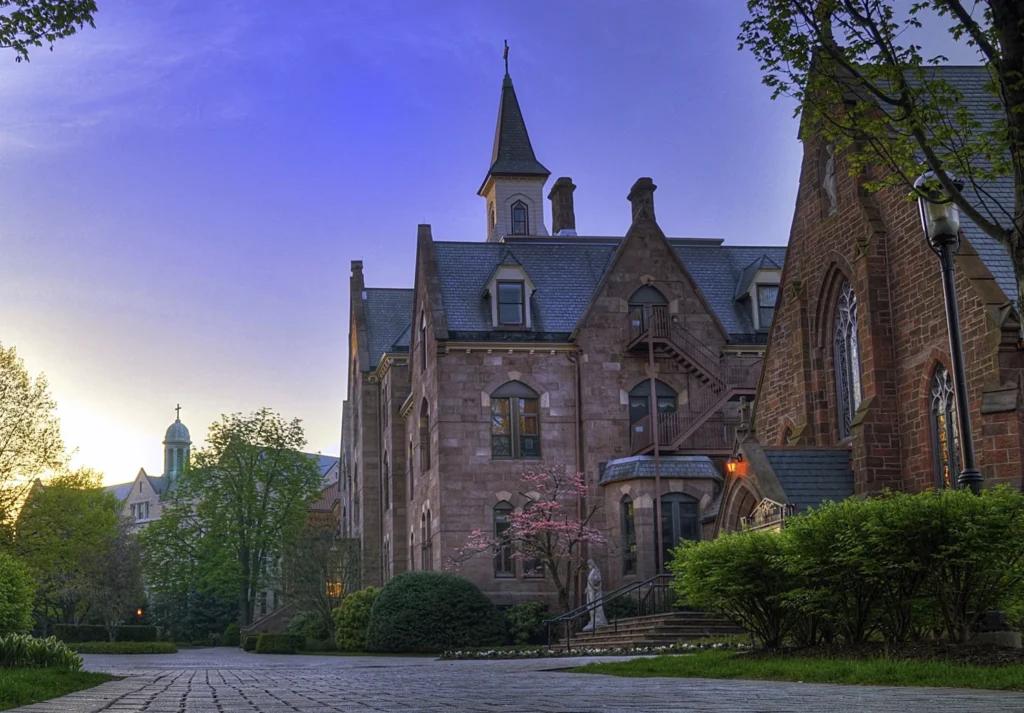
167-year-old Seton Hall University stands as the oldest diocesan university in the United States. Bishop James Roosevelt Bayley, Newark’s first bishop, named it after his aunt Elizabeth Ann Seton, the first American-born saint who pioneered Catholic education. The university has grown substantially since its founding.
This private Catholic research university calls South Orange, New Jersey home. Its “R2: Doctoral Universities – High research activity” classification shows its dedication to academic and scholarly work. The university has expanded well beyond its original campus.
Three main campuses serve different educational needs. The sprawling 58-acre main campus sits in South Orange, New Jersey’s suburban village, just 14 miles from Manhattan. Students here attend the College of Arts and Sciences, College of Human Development, Culture and Media, School of Diplomacy and International Relations, Stillman School of Business, and Immaculate Conception Seminary School of Theology. The Interprofessional Health Sciences campus in Clifton and Nutley houses the College of Nursing and School of Health and Medical Sciences. Law students head over to a separate campus in Newark, New Jersey.
Seton Hall’s student body exceeds 10,000, with 6,146 undergraduates and 3,425 graduate students. Small class sizes average 21 students, and a 14:1 student-to-faculty ratio ensures each student gets personal attention. This approach helps nurture students “in mind, heart and spirit”.
Academic excellence remains the foundation of Seton Hall’s identity. Students can choose from more than 90 challenging undergraduate majors and 130 graduate programs. Nine schools and colleges award degrees in roughly 70 academic fields.
The Department of Social Work and Public Administration offers both undergraduate and graduate social work programs, including the Master of Social Work (MSW). The Council on Social Work Education (CSWE) accredits both the Bachelor of Social Work and MSW programs. U.S. News & World Report ranks the MSW program among the nation’s best social work programs.
Social work programs at Seton Hall emphasize social change, human diversity, cross-cultural awareness, social justice, and service. Graduates learn to become licensed professionals, clinical practitioners, and leaders who serve others in various settings. This aligns perfectly with the university’s mission to develop students who “live their lives responsibly, generously and successfully”.
Programs offered
Seton Hall University’s detailed Master of Social Work (MSW) program features two distinct concentrations that prepare graduates for specialized professional roles. The program emphasizes behavioral health and offers the only graduate forensic social work program in New Jersey. This focused curriculum helps you learn new approaches in behavioral health, substance abuse, healthcare, and forensic practice settings.
The MSW program offers flexible pathway options that fit different educational backgrounds and schedules. Students without an accredited undergraduate social work degree can take the Regular Standing track. This 60-semester-hour track takes two years full-time or up to four years part-time. Students with an accredited Bachelor of Social Work (BSW) from the last five years can choose the Advanced Standing option. This accelerated path takes just one year full-time or two years part-time.
The curriculum has foundation and concentration components. Regular Standing students start with a Foundation Year (30 credits) covering key courses such as:
- Social Policy Analysis
- Social Problems and Programs
- Behavior and Environments
- Theory and Practice
The Concentration Year (30 credits) follows with advanced practice courses including:
- Clinical Evaluation
- Administration and Supervision
- Substance Abuse Theory
- Behavioral Interventions for Chronic Health Conditions
Advanced Standing students complete a three-credit Advanced Standing Seminar in summer before their first semester. This intensive course explores philosophical and ethical foundations of social work practice.
The program combines classroom learning with hands-on field experience effectively. Regular Standing students take synchronous classes either on-campus or online in their first year. The second year features asynchronous online courses. Both tracks include valuable field placements where students apply their knowledge in different settings.
Academic excellence matters throughout the program. Students must maintain a 3.0 cumulative grade point average. Students in the 60-credit program can repeat two courses once to improve grades. However, students in concentration curriculum cannot repeat foundation courses. Advanced Standing students may repeat one course once.
Graduates are ready to work with individuals, families, or groups in advanced-practice settings. Their expertise spans behavioral health, substance abuse, healthcare, and forensic practice.
About the online program
Seton Hall University’s MSW program has expanded its online learning options to meet student needs. Students starting this academic year can now complete their first year through traditional on-campus classes or synchronous online coursework. This change makes the program more accessible without affecting its quality.
Students who pick the synchronous online option will attend virtual classes alongside their on-campus classmates. Live interaction helps create a shared learning environment that builds social work skills. After finishing first-year courses and fieldwork, students move to asynchronous online courses in their second year while continuing on-site fieldwork.
The program structure is different for Advanced Standing students with an accredited BSW. They start with the advanced year right away, taking asynchronous online courses. Working professionals can access course materials and complete assignments according to their schedule.
Hands-on experience stays at the heart of both tracks. Students put classroom theories to work through field placements in real-life settings under supervision. This mix of knowledge and practice opens doors to many career paths after graduation.
Students find many practical benefits in Seton Hall’s online MSW. The program works well for those juggling work or family responsibilities. MSW Program Director Christine Heer puts it well: “Our commitment to delivering exceptional social work education remains steadfast, but we also recognize the importance of flexibility”.
Quality standards guide every aspect of Seton Hall’s online programs. Academic leaders approve online course development, and the university uses the QM™ (Quality Matters) rubric. A standard course management system delivers all online courses.
Faculty experts guide students through specialized areas like trauma, substance abuse, immigration, and LGBTQ+ issues. This mentorship and flexible online format create the perfect setting to develop skills that help students become professional social workers who change lives and communities.
Accreditation
Quality in any Master of Social Work program depends heavily on accreditation. Full accreditation from the Council on Social Work Education (CSWE) marks Seton Hall University’s MSW program as one of the best. The program stands among just eight fully CSWE-accredited MSW programs in New Jersey, showing its 70-year old legacy in the state’s social work education.
CSWE accreditation means more than just recognition. Your job prospects improve significantly with this credential. The accreditation also lets you get professional licenses in New Jersey and across the United States. Your degree carries the same full accreditation status, whether you take the regular or advanced standing track.
Seton Hall University’s MSW program’s quality shines through its U.S. News & World Report ranking. The program sits among the top 30 percent of social work programs nationwide. This outside recognition proves the program’s excellence in academic and professional training.
The Council on Social Work Education, a 1952-founded organization, leads social work education in the United States. CSWE’s strict accreditation process will give a complete check of faculty qualifications, curriculum, and educational outcomes. Students who join Seton Hall’s MSW program enter an environment that showed it meets national professional standards.
CSWE’s accreditation involves a full picture through program self-studies, site visits, and Commission on Accreditation (COA) reviews. Programs must line up with core professional values – service, social justice, human dignity, relationships, integrity, and competence. The curriculum goes through detailed reviews to prepare graduates for skilled professional work.
CSWE accreditation tells students they’re getting the profession’s best education. New Jersey’s state certification requires social workers to graduate from an accredited program. This certification protects public interest and confirms proper education and training. Seton Hall’s accredited MSW program makes you ready for professional certification right after graduation.
Admission Requirements
Seton Hall University’s MSW program has several specific admission criteria. You must have a baccalaureate degree from a regionally accredited college or university. The program looks for candidates with a broad liberal arts background. This includes at least 24 credit hours in courses like sociology, psychology, English, political science or history, statistics, and human biology.
Your academic record should show a minimum 2.75 grade point average on the last 120 graded credits from your bachelor’s degree transcript. Some sources mention a 3.0 GPA requirement for social work courses. Students with strong applications but lower GPAs might receive provisional admission. These students must complete one semester with at least two courses and maintain a 3.0 GPA to continue in the program.
The application package should include:
- Completed application with $75 application fee
- Three letters of recommendation from professors, employers, supervisors, or community associates
- Official transcripts from all post-secondary institutions attended
- Personal statement (3-5 pages) that describes your reasons to apply, personal values, relevant experiences, and career plans
Advanced Standing candidates must have graduated from a CSWE-accredited undergraduate social work program in the last five years. These applicants need extra documents:
- Transcripts that confirm eligibility
- Social Work Department chair’s or director’s recommendation from your undergraduate program
- A detailed evaluation of field instruction experience from agency supervisors
Full-time applicants face specific deadlines – April 30 for fall admission and November 30 for spring admission. Part-time applications work on a rolling basis.
Students can complete prerequisites like statistics and human biology courses by their first semester’s end. All other requirements need completion before admission. The university’s acceptance offers stay conditional until you complete any remaining undergraduate coursework.
Tuition
The cost of your MSW education at Seton Hall University depends on tuition rates and available financial help. Graduate tuition at Seton Hall will cost approximately $1,570 per credit for the 2025-2026 academic year. This represents a substantial investment in your professional future.
Seton Hall offers many ways to help you manage these costs. Students receive nearly $75,000 in direct tuition assistance each year from the Department of Social Work and Public Administration. Your degree costs could drop by up to 50% through scholarships, which makes education much more affordable.
MSW students can apply for these specific scholarships:
- Goya Scholarships – Partial scholarships available to Latino/Latina students who show financial need
- Thomas J. Stanton scholarship – Students can receive this award based on financial need, academic success, and their dedication to leadership and community service in New Jersey
Graduate assistantships provide another great way to get funding. These positions offer full tuition coverage and a monthly stipend when you work about 20 hours weekly in a campus office. While competition is fierce, qualified candidates can receive substantial financial support.
Submit your application by April 30 to improve your chances of getting departmental scholarships. The Free Application for Federal Student Aid (FAFSA) deadline is January 15. This meets Seton Hall’s priority date and helps you qualify for all available financial aid.
You can also access Direct Unsubsidized Loans, Direct PLUS Loans, alternative student loan programs, and payment plans. Merit awards could cover anywhere from several thousand dollars to 50% of your first-year tuition right after admission.
Seton Hall University’s Office of Financial Aid team will help you understand loan eligibility, complete FAFSA applications, and answer your financial questions throughout your educational trip.
Additional Information
Seton Hall’s MSW program provides extensive professional development resources that go way beyond the reach and influence of regular coursework. Students and graduates can make use of the Career Center’s services. The center provides career advice, access to job databases with thousands of opportunities, and panels featuring industry experts. Graduates become part of a dynamic alumni network and can participate in regional chapter events, social activities, and networking meetups.
Your MSW experience revolves around practical fieldwork as its substance. Students head over to a variety of settings—healthcare facilities, mental health centers, schools, community organizations—where they apply classroom theories in real-world situations. A student who completed fieldwork at The Elizabeth Coalition to House the Homeless shared: “homelessness is a prevalent problem here in New Jersey, and one that social workers have a great role in offering support”.
Top performing MSW students with a minimum 3.0 GPA qualify to join the Alpha Theta Chapter of The National Social Work Honor Society. Senior social work students pursuing careers in child protective services can apply for the Baccalaureate Child Welfare Education Program (BCWEP). This program offers full scholarships with stipends.
Students can participate in community service, extra learning activities, and curriculum discussions through the Social Work Student Organization. The organization creates opportunities outside traditional classroom settings.