
Salisbury University MSW: Your Guide to Admission Requirements & Program Options
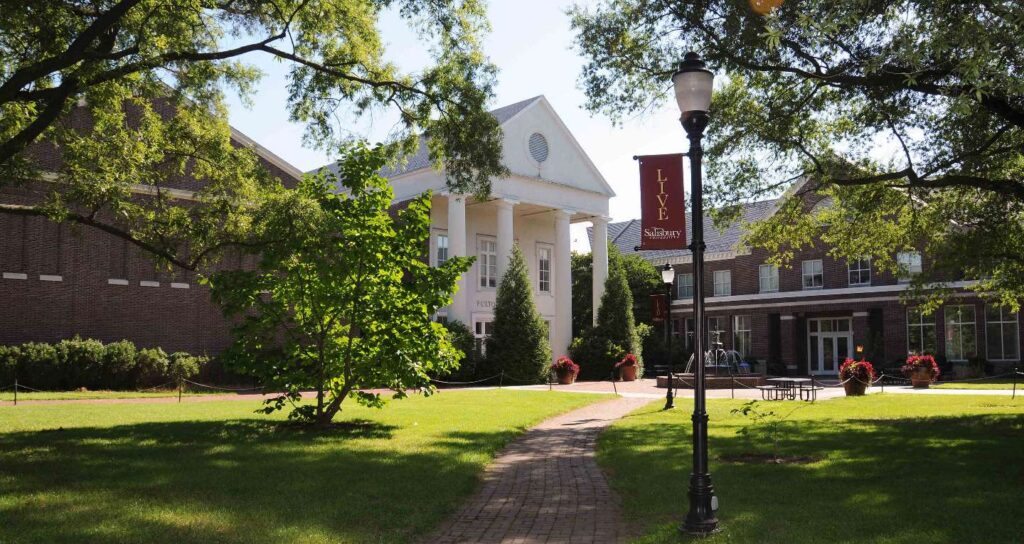
Founded in 1974, Salisbury University’s School of Social Work has grown into a thriving institution that prepares culturally responsive social work professionals. The school has expanded significantly over the last several years to offer a dual-degree program in sociology and social work, five satellite locations across Maryland, and a fully online master’s program.
Faculty members focus on teaching excellence and student success. The program combines innovative classroom instruction with hands-on field experience to prepare students for challenges they’ll face on the ground.
The Council on Social Work Education (CSWE) fully accredits all programs at Salisbury University’s School of Social Work. This accreditation serves as a vital requirement to earn social work licensure in the United States. The MSW program earned its CSWE accreditation in 2004.
Students become skilled at advanced practice with individuals, families, and groups through the school’s focused mission. Graduates work with high autonomy and skill while actively pursuing social and economic justice in their communities.
The Bureau of Labor Statistics projects social worker jobs will grow faster than average in the next decade. Bilingual social workers and those ready to serve rural, underserved communities will find expanding job opportunities.
Salisbury University helps working professionals by offering evening and summer courses that fit their schedule. Students can attend the MSW program at the main Salisbury campus or any of four satellite locations throughout Maryland. Regional campuses use a hybrid format with classes starting at 5 p.m., and students need to attend in person only once or twice weekly.
The university offers one of Maryland’s most affordable online MSW programs. Students at regional locations benefit from a mix of face-to-face classes and interactive live video sessions with Salisbury University faculty.
Programs offered
Salisbury University’s Master of Social Work program has a well-laid-out curriculum that helps students achieve their full potential. Students can choose flexible pathways based on their educational background and career goals.
The university offers two MSW specializations:
- Clinical Social Work and Advocacy Specialization – This track prepares students to work with individuals, families, and small groups. Students learn interventions that improve person-in-environment fit and address biopsychosocial functioning. Career opportunities exist in mental health clinics, healthcare facilities, family service agencies, schools, veterans services, recovery programs, and private practice.
- Social Change and Leadership Specialization – Students in this pathway learn to work with organizations and communities to solve systemic issues and create equitable social structures. Graduates often work in local, state, and federal agencies, non-profit advocacy organizations, health and human service agencies, and political campaigns.
Core classes in both specializations promote anti-discriminatory practice with diverse populations. Students learn about trauma, resiliency, and justice. The tracks build strong foundations in advocacy for underserved and historically marginalized populations.
The Traditional MSW Program needs 62 semester hours if you don’t have an accredited undergraduate social work degree. Students complete 30 hours of generalist coursework and 32 hours of specialized instruction. Full-time students finish in two years, while part-time students complete the program in four years.
Advanced Standing is available to graduates from CSWE-accredited undergraduate social work programs within the last three years (or five years with two years of human service experience). Full-time advanced standing students complete their degree in one year, while part-time students finish in two years.
Students can choose between hybrid and fully online formats for all program options. The online MSW uses a 20-student cohort model with fall admission. Courses run in 7-week blocks throughout the year. Traditional students complete their degree in three years, while advanced standing students finish in 17 months.
Field education plays a vital role in both tracks. Current placements are available in community mental health agencies, child welfare organizations, county health departments, and area schools. These practical experiences prepare graduates to become leaders who implement socially just, culturally-responsive, and evidence-based interventions.
Program details
Salisbury University’s MSW program gives students a perfect mix of theory and hands-on experience to prepare them for social work careers. The coursework takes a close look at human behavior, social welfare policy, research methods, and clinical practice techniques. Students develop their critical thinking abilities and practical skills that they’ll need to become effective social workers.
Field education is the substance of the MSW experience. Students get hands-on training with professional supervision that helps them apply classroom concepts in real-life settings. Experienced practitioners guide students through their work at healthcare facilities, community agencies, schools, and government organizations.
The program follows a well-laid-out sequence. Students start with the basics before moving to specialized content. Traditional programs begin with generalist courses that cover social work history, ethics, diversity, and fundamental practice methods. Later courses match students’ chosen concentration and provide deeper knowledge of advanced intervention techniques and population-specific approaches.
Working professionals will find Salisbury University’s flexible scheduling fits their busy lives. Evening classes start at 5:00 PM, so students can keep their jobs while earning their degree. The hybrid format needs just one or two campus visits each week. Face-to-face classes combine with online learning to make this possible.
The online MSW option delivers quality education in a structured, easy-to-follow format. Students focus on one subject at a time in 7-week blocks throughout the year. Traditional students can finish their degree in three years, while advanced standing students complete it in about 17 months.
Faculty members bring both field experience and academic credentials to their teaching. Their real-life insights make learning more meaningful. Small classes help build strong relationships between students and professors. This shared learning environment encourages professional growth through mentorship and peer learning opportunities.
About the online program
Salisbury University’s online MSW program excels in three key areas: accessibility, affordability, and academic excellence. Students can advance their social work careers through this fully accredited online program without moving or leaving their current jobs.
The program offers one of the most affordable online MSW options in Maryland. This makes advanced social work education accessible to more aspiring professionals. Students who live in counties next to Maryland might qualify for the Good Neighbors Graduate Scholarship program. This scholarship can help reduce tuition costs even more.
Students experience the same high standards and complete curriculum as on-campus students. The program’s well-laid-out sequential coursework helps students reach their full potential in both generalist and specialized practice. The online format keeps the program’s signature student-centered, supportive environment.
Students can choose from multiple flexible pathways:
- Traditional Program: Students without an accredited undergraduate social work degree need 62 semester hours. Full-time students can finish this online program in three years. They study year-round in 7-week course blocks.
- Advanced Standing: Qualified BSW graduates can complete this accelerated option in about 17 months through the online format.
Both paths share the same field education requirements as the in-person program. Students gain practical skills and theoretical knowledge. Traditional program students must complete two different field placements during their studies.
Each online cohort has just 20 students. This small group size encourages close connections among classmates despite the virtual setting. Students support each other in this collaborative learning community throughout their educational trip. The online MSW program prepares students for advanced direct practice with individuals, families, groups, and organizations just as effectively as the in-person program.
Accreditation
Quality assurance at Salisbury University’s MSW program relies on professional accreditation. The Master of Social Work program has full accreditation from the Council on Social Work Education (CSWE). This credential shows the program meets national standards for social work education and professional preparation.
Your future career depends heavily on CSWE accreditation. Students who graduate from an accredited program can get social work licensure after graduation. Licensing boards throughout the United States require CSWE accreditation before granting licensure eligibility.
Salisbury University has earned institutional accreditation from the Middle States Commission on Higher Education. This recognition validates the university’s academic quality and effectiveness. The U.S. Department of Education and the Council for Higher Education Accreditation both recognize the Middle States Commission as an institutional accrediting agency.
Every CSWE program tracks and reports student learning outcomes based on professional competencies. Social workers must become skilled at these competencies during their professional training. Salisbury University aims to have 80% of its students show mastery of individual competencies by the time they complete their training.
Salisbury University’s School of Social Work believes in open assessment practices. Students can access reports that show mastery levels of core competencies in all program options. This focus on measuring outcomes shows the program’s steadfast dedication to educational excellence and continuous improvement.
The university’s undergraduate and graduate social work programs are both fully CSWE accredited. This detailed accreditation covers all program formats, including the online MSW option. Whatever pathway you choose, your Salisbury University social work education meets professional standards and prepares you for licensure.
Admission Requirements
The Salisbury University MSW program has specific requirements and needs a complete application package. You must have a baccalaureate degree from a regionally accredited college or university. The admission process includes detailed academic and professional requirements beyond this simple qualification.
Students need at least 24 credit hours in a broad liberal arts background. Your coursework should include sociology, psychology, and statistics. Some programs also need English, political science, or history. You can complete any missing prerequisites during your first semester after admission.
The program’s academic standards require a minimum 3.0 GPA. This applies to both your last 120 graded credits and final 60 graded upper-division credits from your bachelor’s degree. Advanced standing applicants need a higher 3.2 GPA on their last 60 upper-division credits.
Your application must include:
- Three professional letters of recommendation from professors, employers, supervisors, or professional colleagues
- A detailed personal statement that addresses specific prompts
- A complete resume
- Official transcripts from all colleges attended
- A $65 non-refundable application fee
Advanced standing candidates must graduate from a CSWE-accredited undergraduate social work program in the last three years. Those with two years of human service work who graduated within five years might also qualify. These applicants need to submit field evaluations and specific recommendations.
The program offers provisional admission for applicants with GPAs between 2.5-2.99 (2.8-2.99 for advanced standing). Provisional admits must complete one semester with at least two courses and maintain a 3.0 GPA.
International students must meet extra requirements, including minimum TOEFL scores of 550 paper/79 IBT. The program requires all application materials by the published deadlines for your intended start term.
Tuition
Tuition costs play a significant role in choosing your MSW program. Salisbury University’s 2025-2026 rates remain competitive and vary by residency status and program format. Maryland residents currently pay $445 per credit hour while out-of-state students pay $805 per credit hour. Students should note that mandatory fees raise these rates to $574 for in-state students and $934 for out-of-state students.
Students at the Hagerstown campus get a better deal. Out-of-state students pay a reduced rate of $664 per credit hour including fees. The total direct costs for tuition and mandatory fees reach $10,332 for Maryland residents and $16,812 for non-residents yearly.
The 15-year old university provides several financial aid programs to reduce these costs. The Good Neighbors Graduate Scholarship helps active students from counties near Maryland save money. Students in the online MSW program can benefit from the Federal Service Scholarship, which cuts the standard rate from $820 to $574 per credit hour.
These scholarships bring the total program cost down to $35,588 for Traditional MSW students and $18,368 for Advanced Standing students after Federal Service Scholarship. Students can save up to $15,252 in Traditional programs and $7,872 in Advanced Standing programs.
Maryland residents need to budget $30,068 for total attendance costs, while non-residents should expect $36,548. Students can access various financial aid options, but they must submit applications by the vital March 1 deadline for financial awards.
Additional Information
Salisbury University provides comprehensive student support services to boost your MSW experience. The Academic Advising Center helps you find specialized resources throughout your educational experience. The Career Services office guides you from choosing your specialization to finding jobs after graduation.
Students can get valuable help at the Center for Student Achievement. It provides tutoring, success coaching and supplemental instruction to help you reach your full academic potential. The Math Emporium gives you tutoring support for mathematics courses of all levels.
Salisbury University makes your health and wellbeing a top priority. Student Health Services helps you succeed through clinical care and wellness programs. The Counseling Center provides confidential mental health support for any psychological concerns you might face.
The Office of Access & Accommodations helps create learning opportunities that work for everyone. Starting Fall 2025, this office will also support students’ religious observance needs.
Students pursuing the online MSW option must have access to specific technologies:
- Laptop or desktop computer
- High-speed internet connection
- USB microphone with headset
- Webcam
- Microsoft Office Suite and other required software
You’ll need to prepare for your licensing exam before graduation since licensure is required to practice social work professionally in the United States. Student memberships in professional associations like NASW or ASWB are a great way to get professional development opportunities.